// Production / Inference Optimization
Distillation. Smaller models, same answers.
Teacher-student training that takes a 70B model and gives you a 7B that holds up on your evals - at a fraction of the cost. We tell you when distillation is the wrong tool.
// What we see
The frontier API bill is the symptom. The task is too narrow to justify it.
01
GPT-5 pricing on a classification step
Retrieval-rerankers, intent classifiers, domain extractors run thousands of times a day. Teams reach for the frontier model and pay $40K/month for a task a 3B fine-tune nails at $2K.
02
Latency the product team sold that the model can't hit
The product commits to sub-500ms; the 70B model takes 2 seconds on a loaded cluster. Swapping to a well-distilled 7B often closes that gap without touching the application.
03
Provider dependency baked into the unit economics
Every pricing change from OpenAI or Anthropic reprices the P&L, and every model update is a regression risk nobody tested. Teams discover this during a vendor negotiation.
// Case Study
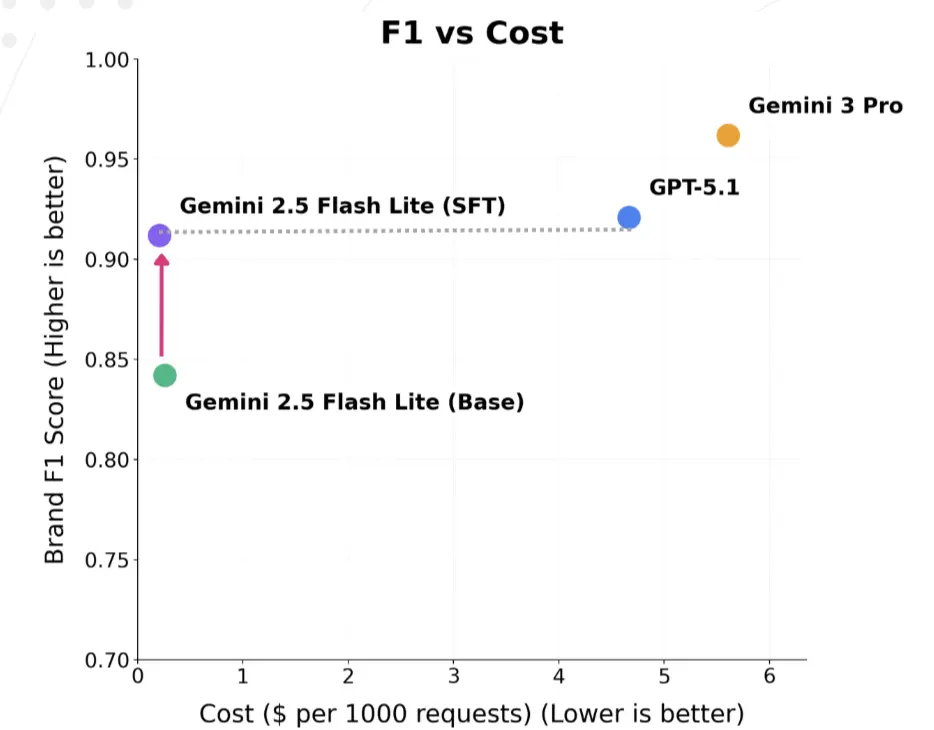
Fine-tuned a small model to frontier quality - 50× cheaper at high volume
Customer's frontier-API entity-extraction pipeline worked but the per-token bill was eating margin at the volume they wanted to ship at. We split the task into hybrid retrieval + two fine-tuned Gemini 2.5 Flash Lite models. 98.3% F1 retention on the customer's existing eval suite, ~50× cheaper per 1000 requests, ~3× faster - without touching the prompt or the eval.
50×
cheaper per 1000 requests
3×
lower end-to-end latency
98.3%
F1 retention vs. frontier-API baseline
// What we deliver
Distillation pipelines, end to end.
From teacher selection to deployed student, with the eval harness checked into your repo so you can repeat it next quarter.
Teacher and student selection
The teacher sets the ceiling, the student sets the floor - we profile both before training starts.
- Open-weight teachers: Llama, Qwen, DeepSeek, Mistral
- Closed-model distillation via API logs and synthetic generation
- Student sized to your latency budget, not arbitrary parameter count
- Architecture matching where it helps, divergence where it pays off
Distillation losses that work
KL divergence on logits is the textbook answer. Production wants attention transfer, hidden-state matching, and task-specific objectives.
- Soft-target KL divergence with temperature tuning
- MSE on logits for sequence-level transfer
- Hidden state and attention matrix alignment
- Combined CE + distillation losses with curriculum scheduling
Distillation dataset curation
We mine your traffic, generate from the teacher, and filter aggressively - teacher mistakes become student dogma.
- Traffic mining and PII-safe replay from production
- Teacher generation with self-consistency filtering
- Difficulty-aware sampling so the student learns the hard cases
- Domain coverage audits against your taxonomy
Eval harness and regression reports
Every distilled model goes through a custom eval suite tied to deploy gates.
- Task-specific eval suites, not just MMLU and GSM8K
- Per-segment regression analysis on your real traffic
- Pairwise judge models for open-ended tasks
- Cost-per-quality curves so the tradeoff is explicit
Distillation vs alternatives
Sometimes quantization or a sharper prompt with a smaller stock model wins. We tell you which lever to pull.
- Quantization (AWQ, GPTQ, FP8) where the model is already small
- Pruning and structured sparsity where compute is the bottleneck
- LoRA and adapter routing instead of a full distillation
- Honest recommendation when no compression is the answer
Production rollout and watch
Distilled models behave differently under real traffic. We instrument the rollout so regressions don't surface in customer tickets.
- Shadow deployment alongside the teacher for direct comparison
- Canary rollout gated on live eval metrics
- Drift detection on input distribution and output quality
- Easy rollback path with the teacher kept warm during ramp
// Method fit
Distillation earns its cost when the task is narrow and high-volume.
skip it if
Quantization gets you close enough
If the cost gap is modest, AWQ INT4 or FP8 quantization gets 30-50% savings at near-zero engineering cost. Run the benchmark first.
The task keeps shifting
Distillation locks in a snapshot. Pre-PMF, you'll retrain before the deployment pays back - ship on the frontier API, then distill what stabilizes.
Your teacher isn't reliable on the task
If the teacher hallucinates 10% on your domain, the student learns to hallucinate more efficiently. Fix the teacher first, then distill.
The payback period is longer than 3 months
Engagement cost vs. monthly inference savings: if ROI takes longer than 3 months, it rarely makes sense - models change too fast.
use it if
You have a high-volume, narrow task - extraction, classification, structured output, domain Q&A - where a frontier model is 5-20x more expensive than the task warrants.
Your teacher is consistently correct on that task (>90% eval score on your data) and you have enough production traffic to mine for training examples.
You want a reproducible training pipeline you can re-run as the task evolves. The pipeline is the deliverable; the first student is just the first run.
// How we work
Eval first. Teach on filtered data. Shadow before you swap.
The number we're moving is 'student quality within X points of teacher at Y cost.' Without a task-specific eval in place before training starts, distillation is guesswork dressed up as engineering.
01
Eval design + teacher profiling (week one)
Task-specific eval suite built from your production traces. We profile the teacher against it - per-segment accuracy, hallucination rate, tail failures. The teacher gap sets the student's quality bar.
02
Dataset construction + distillation run
Traffic mined with PII-safe replay, teacher generation with self-consistency filtering, reward-model scoring (20-40% kept). Losses chosen per task. Pilot on 10K examples validates the recipe before the full run.
03
Shadow deployment + handoff
Student deployed alongside the teacher on real traffic, canary ramp once shadow metrics hold. Handoff: training pipeline as code in your repo, eval suite in CI, and a retraining runbook.

// Expert insight
“The mistake we see is teams distilling against academic benchmarks and then deploying for a product that looks nothing like MMLU. The eval has to be your eval - built from your traffic, judged the way your customers judge - or the distilled model will pass the test and fail the launch.”
Karol Gawron
Head of R&D @ bards.ai
// Why bards.ai
Researchers who train. Engineers who deploy.
Distillation is half ML research, half production engineering. We do both, and we don't hand off between them.
16+ open-source models on Hugging Face
80K+ monthly downloads. We've trained, distilled, and shipped models people actually use - not just papers about them.
CLARIN-PL spinoff, NLP research roots
We came out of one of Europe's strongest NLP research labs. Distillation losses and curriculum scheduling are not new territory for us.
Production training at scale
Multi-node training on H100s, FSDP, mixed precision, and the boring infrastructure that makes long runs not blow up overnight.
Eval harnesses we ship with
Every project includes a task-specific eval harness in your repo - so the next distillation, fine-tune, or prompt change is measurable too.
On-prem & air-gapped capable
We can train on your hardware, with your data, behind your firewall - including environments where outbound network is blocked.
Every engineer has run the full loop
Dataset curation, multi-node training runs, eval harnesses, shadow rollout - the people scoping your distillation have done each step on production models before.
// FAQ
Common questions about model distillation
On task-specific evals, a well-distilled student typically lands within 1-3 percentage points of a teacher 10x its size - sometimes closer when the task is narrow. On open-ended general evals the gap is larger. We measure this on your evals before promising anything, and we'll walk away if the regression is unacceptable.
They solve different problems. Quantization is cheapest when your model is already small enough - drop to FP8 or AWQ INT4 and ship. Pruning helps when compute, not memory, is the bottleneck. Distillation is the right choice when you need to drop one or two orders of magnitude in size and quantizing the big model isn't enough. Often the answer is a combination.
Yes - via API output distillation. We replay or generate prompts, capture teacher outputs, and train an open-weight student on the resulting dataset. Quality depends heavily on dataset coverage and filtering. Check your provider's terms of service first; some prohibit using outputs to train competing models.
Less than you'd think for narrow tasks - tens of thousands of high-quality teacher-labeled examples can be enough for a focused student. Broader behavior transfer wants hundreds of thousands to millions of examples, often generated and filtered. We typically combine real traffic, teacher synthetic generation, and curated public data.
We build a task-specific eval suite from your traffic and your acceptance criteria - not just MMLU and HellaSwag. For open-ended outputs we use pairwise judge models, often a separate strong LLM, validated against human ratings on a sample. The harness is checked into your repo so you can re-run it next quarter when something changes.
End-to-end distillation projects typically run 4 to 8 weeks. The first two weeks are dataset construction and eval harness; the next two to three are training and iteration; the rest is rollout and monitoring. We work in weekly increments with a measurable artifact at the end of each week.
Yes - we routinely train on customer infrastructure, including on-prem H100 clusters and air-gapped environments. We bring the training stack (FSDP, mixed precision, eval harness, checkpointing) and operate it on your boxes. Your data and your weights never leave your perimeter.
// Related services
Adjacent problems we solve
- Learn more
Inference Optimization
Triton Inference Server Deployment
TensorRT, ONNX, and PyTorch behind one gRPC endpoint, with dynamic batching tuned for 2-4x more throughput per GPU.
- Learn more
Inference Optimization
LLM Deployment on Ray Serve
Ray Serve and vLLM clusters tuned for p99 latency and spend - built by engineers who've served 1B+ tokens a day.
- Learn more
Agentic Workflows & RAG
LangGraph Agents
Postgres checkpointing, recursion budgets, and eval gates that keep LangGraph agents alive under real traffic - on your infra, operated by your team.
// Let's ship it
Cut your inference bill without cutting your quality.
A distillation plan, an eval design, and a number - usually within a business day. That's what comes back once you share your teacher, task, and latency budget.
Karol Gawron
Head of R&D @ bards.ai