// Research / Computer Vision
Object detection that holds up on your data.
We build custom detectors and segmenters for the objects public datasets miss - labeled with foundation-model loops, trained for your latency budget, and shipped to the GPU or edge device that runs in production.
// What we see
Generic models pass the demo. Production has a different bar.
01
The long tail eats the accuracy
Pre-trained YOLO handles the 80% of scenes that look like COCO. Production traffic is the other 20% - weird angles, occlusion, your lighting, your objects. Headline mAP looks fine; complaints don't.
02
Labels are 80% of the project
Most teams pick the detector first and the labeling pipeline last. The architecture you can swap in a week - the 50,000 labeled images you cannot.
03
The model fits the laptop, not the device
It hits 0.91 mAP on an A100 in your notebook - then it has to run on a Jetson Orin at 30 FPS, or a CPU-only server processing 200 camera feeds.
// Case Study
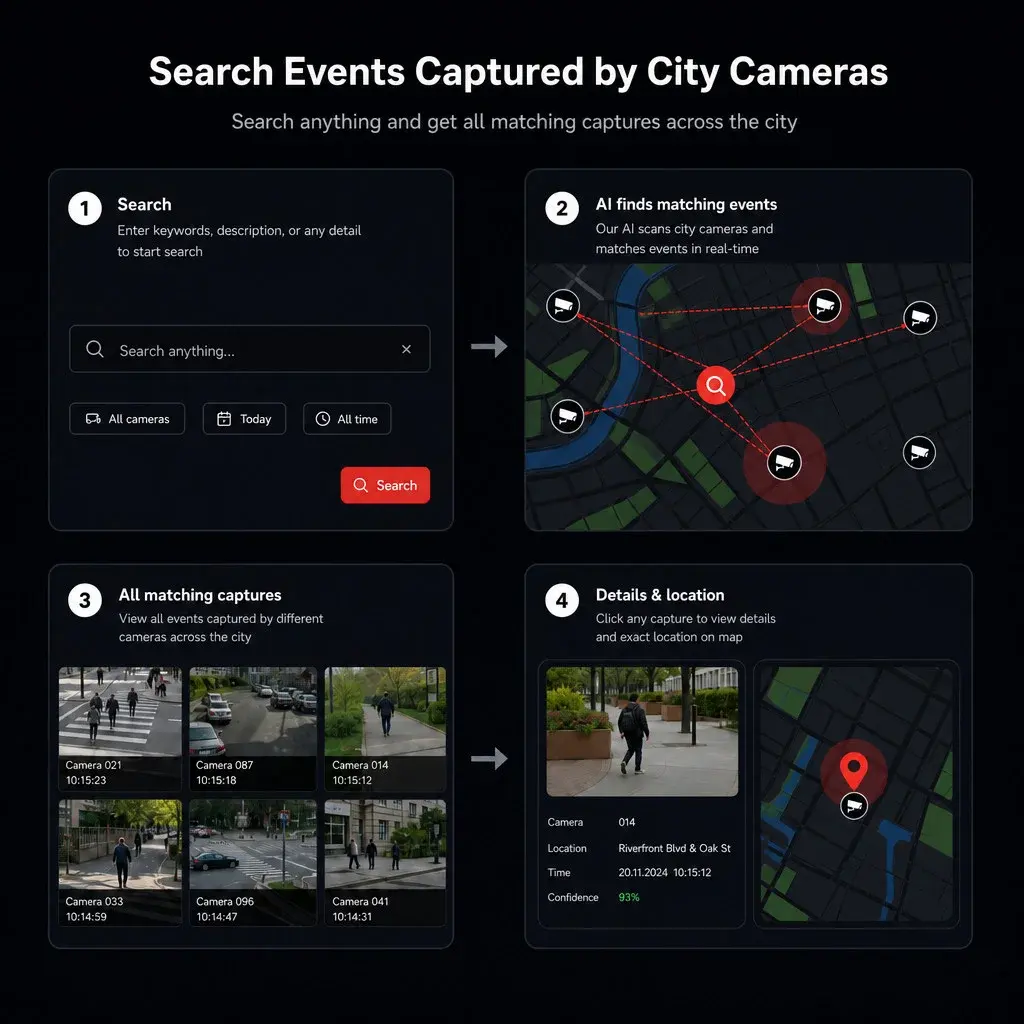
Text-search across 200 live city camera feeds
Municipal operators type a description and the system surfaces matching events from across the city's live CCTV network. We built it for Neural; the City of Oława's Straż Miejska runs it on-prem. 200 cameras per server; review time on a typical incident dropped from ~8 hours of manual scrubbing to under 1 hour - an ~88% reduction.
200
live cameras per on-prem server
~88%
less time per incident review
~33K
residents covered (Oława)
// What we do
Three things that decide whether the detector ships.
Most production CV problems aren't solved by a better architecture. They're solved by the labeling loop, the right hardware target picked early, and an eval that sees the slices mAP hides.
Foundation-model labeling loops
A few hundred annotated images become tens of thousands of verified pseudo labels.
- Grounding DINO, SAM 2, CLIP-based weak supervision
- Humans verify rather than label from scratch
- 3-5x faster, higher inter-annotator agreement
Architecture chosen for your hardware
We profile candidate models on your target device before final selection.
- YOLOv11 for 60 FPS edge
- RT-DETR for accuracy on big GPUs
- EfficientDet when memory is tight
Eval beyond a single mAP number
A single mAP hides every failure that matters - we slice the eval.
- Per class, scene type, occlusion, small-object size, low-light
- Hard-negatives suite from real production failures
// Method fit
Custom detection isn't the right tool for every CV problem.
skip it if
A cloud API covers your objects
Common objects from common viewpoints - people, cars, faces, logos - are covered by AWS Rekognition, GCP Vertex Vision, Azure CV with no training.
Your real problem is OCR or document layout
Reading text, extracting tables, parsing forms are document-AI problems with their own toolchain - LayoutLM, Donut, OCR engines.
Document AI & OCRYou only need a label, not a box
If 'is there a forklift in this frame' is enough, a fine-tuned classifier needs 5-10x less labeling than a detector.
use it if
Custom detection fits when you have proprietary visual data, unusual viewpoints or environments, latency or hardware constraints that rule out cloud APIs, or industry-specific classes public datasets don't cover.
// How we work
Hardware audit first. Iterate in the open. Hand off the retraining loop.
Every CV engagement starts with the constraints that are expensive to undo - target hardware, latency budget, label availability. The model gets picked after those are known, not before.
01
Data and hardware audit (week one)
We profile sample data, benchmark candidate detectors on your actual target device, and write down the labeling budget. Your engineers approve the design before any training run.
02
Iterate in a shared workspace
Every training run lands in a Weights & Biases or MLflow workspace your engineers can see - loss curves, per-class precision, failure-case montages, live.
03
Hand off the retraining loop
We hand off the model export (TensorRT, ONNX, OpenVINO), the eval suite, the labeling pipeline, and a retraining runbook. Slack for 30 days after delivery.
// Expert insight
“Most teams pick the detector first and the labeling pipeline last. That's backwards. The architecture you can swap in a week. The 50,000 labeled images you can't. Foundation models changed what's possible for a labeling budget - the team that adopts that loop early ships in half the time.”
Norbert Ropiak
Co-founder @ bards.ai
// Why bards.ai
Millions of VOD screenshots a day. 200 live CCTV feeds. Still running.
You could hire the team - it would take a year and they'd learn your hardware constraints on you. We already learned them at Comcast and Oława's municipal CCTV network.
Production CV deployments at scale
Comcast's UI element detector runs daily on millions of VOD screenshots. Neural's video-search runs on-prem in Oława across 200 live CCTV feeds.
Edge and on-prem deployment, not just GPU
TensorRT, ONNX Runtime, OpenVINO, Triton, Jetson Orin, and CPU-only on-prem boxes. We benchmark on your hardware before committing to a frame rate.
Foundation-model labeling loops as default
Grounding DINO and SAM 2 annotation pipelines on every engagement - across industrial, surveillance, retail, medical datasets. The 3-5x labeling speedup is repeatable.
10+ peer-reviewed CV and ML publications
CLARIN-PL spinoff. Published on detection, segmentation, and representation learning - the per-class eval discipline in every harness comes from that rigor.
16+ open-source models on Hugging Face
80K+ monthly downloads across NLP and CV. We publish the models we build. Proof of engineering before you sign anything.
Detectors shipped to paying customers
Everyone on your engagement has taken a detector from labeling plan to production hardware and owned the retraining loop after handoff.
// FAQ
Common questions about custom object detection
With foundation-model bootstrapping (Grounding DINO + SAM 2 pseudo labels, human verification), useful detectors start at 200-500 verified samples. Production-grade accuracy on most tasks lands in the 2-5K range. Without bootstrapping, multiply by 5-10x. The first thing we measure is your label budget; the architecture comes after.
Yes. We profile the candidate models on the target device in week one - before final architecture selection - so we don't over-train a model that won't fit. Jetson Orin AGX runs YOLOv11s at 30-60 FPS with INT8 quantization. CPU-only servers run smaller variants or batched inference for offline pipelines. We benchmark before we commit.
Cloud APIs are great when your objects look like the COCO/ImageNet distribution. They fall over on industry-specific classes, unusual viewpoints, regulated data that can't leave the customer perimeter, and edge deployment without internet. Custom models also let you tune the precision/recall tradeoff per class and own the retraining loop.
YOLOv11 is the default for edge and latency-constrained workloads - it runs at 30-120 FPS on Jetson Orin, L4, and T4 with INT8 quantization and covers most industrial, retail, and surveillance use cases without modification. RT-DETR is the pick when accuracy is the hard constraint and you have GPU headroom: it closes the gap on small objects, dense occlusion, and unusual aspect ratios, but runs 3-5x slower at similar parameter counts. EfficientDet and YOLO-NAS for memory-limited deployments. We benchmark candidate architectures on your target device in week one before committing - frames-per-second at your accuracy threshold on your hardware matters more than COCO leaderboard rank.
Yes - streaming inference is the standard production case for surveillance, manufacturing quality control, and automated inspection. The pipeline handles RTSP and RTMP ingestion, GStreamer or OpenCV-based capture, and GPU batching across concurrent streams. A single L40S processes 4-16 streams at detection grade depending on resolution and frame rate. On-device Jetson Orin runs 1-4 streams for edge deployments where video can't leave the facility. We design the ingestion pipeline alongside the model so end-to-end latency from frame capture to detection result meets your SLA - typically 50-200ms for real-time alerting.
Typically 6-12 weeks. Weeks 1-2: hardware audit, sample data profiling, target-device benchmarks, labeling plan. Weeks 2-5: annotation pipeline with foundation-model bootstrapping, initial label batch. Weeks 5-8: training iterations, per-class and per-scene eval, hard-negative mining. Weeks 8-12: deployment packaging (TensorRT or ONNX or OpenVINO), inference server wiring, monitoring, and runbook handoff. Timeline is most affected by label volume and the number of novel failure modes that surface in the first training run - we scope this in week one with explicit milestones.
// Related services
Adjacent problems we solve
- Learn more
Computer Vision
Document AI & OCR Pipelines
Layout-aware extraction, line-item invoice parsing, and handwriting - 98% field accuracy at under 300ms per page, deployable in your VPC.
- Learn more
Computer Vision
Medical AI & Imaging Computer Vision
DICOM-native pipelines and validation methodology a journal would publish, deployed inside the hospital VLAN.
- Learn more
Computer Vision
Liveness Detection & Biometric Authentication
ISO 30107-3 passive liveness and face verification - over 99% attack rejection at 1-3% false rejection, on-device or server-side.
// Let's ship it
From a folder of images to a detector on your hardware.
What are the objects, the environment, the hardware? We'll come back with a labeling plan, an architecture pick, and a device benchmark - usually within a business day.
- Engagements from
- $40K
- Typical range
- $40K-$120K
- Duration
- 4-8 weeks
Fixed-fee proposal after the first scoping call. Scope drivers: labeling scope, target hardware complexity, segmentation requirements, greenfield eval suite.
Norbert Ropiak
Co-founder @ bards.ai